Tuesday, November 3, 2015

UNFORGIVNG GRANDMA JONES

The year was 1918. A dreadful outbreak of influenza was sweeping our nation, indeed the entire world. World War I was coming to an end and by November when the peace treaty was signed with Germany our troops overseas would be looking homeward, only to arrive to the deadly threat of the “Spanish Flu”. 

Eliza Jane Holcroft of Choctaw, Oklahoma, was fifty-one years old and worn out. 
The mother of thirteen children, she buried her husband of thirty-one years, James Archibald Jones, in 1917. She buried her oldest daughter, Nellie Grace, mother of two small boys, when Nellie was only twenty-three years old. Eliza knew hard times. Now her second-oldest daughter, Nora Olive, was pregnant with her fourth child and living in far off Moffat County, Colorado, with her husband Tom Smith and their three other children.

Tom, Nora, and family were homesteading in Bear Valley, north and west of Craig, out in the boonies, but Tom brought Nora into Craig for the impending birth of the child. I’m sure she would have benefited from her mother’s presence and from the letter that Eliza wrote to Nora, I know that her mother wanted to be there. I’ll let the letter speak for itself.

“Choctaw, Oklahoma August 4, 1918

My Dear Daughter and family;

I will try to answer your always gladly received letter that come to hand some time ago. We are all well at present. I have a very sore finger so I can hardly write. We have had a houseful of company today so I didn’t get to go to S.S. (Sunday School?) They come after peaches, we let go three bushels today. Have sold 30 dollars worth so far. We are getting 2 dollars a bushel here at the place. We could get 2.50 in the city but we have such a few I guess we will sell them all here at the place.

Well, Nora, I have made my settlement with the court and I am so short of money that I do not feel like it would be right for me to take all the money we have to come out there and I would not have enough to make the round trip so I guess I will have to wait awhile. I know it looks like if I come at all I ought to come now but we are needing rain awful bad and don’t know if we will make a crop to speak of and I have the children to think of besides myself, but in spite of all of this I would sure like to come first on your account, as I do not think I am interested in the land proposition out there as much as I was. It would take at least three hundred dollars to take us out there and it would take me a long time to earn that much money and I think if we do not farm next year that the money I would spend out there would start me in a little business of my own. Surely you will come home sometime this fall or winter. Well Nora if I knew we would make a good crop I would run the risk and come out there but I don’t know and we haven’t hardly any fruit like we had last year. I sure do wish you could have come out here. I would have been able to get by. Bertha (Nora’s younger sister) would stay while you were down. I have not been as stout this summer as usual and it seemed like the work just piled up and I couldn’t get it done. No, we don’t have any vegetables except spuds and corn and cowpeas. Our tomatoes are late so they are not ripening very fast. We had a few for dinner sliced. Well Nora I am glad you have company. Maybe you won’t be so lonesome. Try to get all of the enjoyment out of your company that you can.

Monday morn the 5th . I will finish my letter. I am heartily ashamed of not writing sooner but it seems like there never was quite as much to do but the peaches will soon be out of the way. Labe (Nora’s younger brother) came back yesterday. He had been gone ever since before the 4th of July. Tell Ola (Nora’s oldest child) Goldie (Nora’s youngest sister) has taken her first music lesson. She will take half a lesson at a time and twice a week. My finger is no better. I am a little afraid of a felon. I must close. Be sure to write soon and I will do better next time. I am as ever your loving mother. E J Jones”

Nora gave birth to her last child whom she named Jennie Frances Smith on September 12, 1918. In a weakened state from childbirth Nora succumed to the flu and died on October 23, 1918; she was buried in Craig. I’ve been told that it was Bertha, Nora’s sister four years younger, who came out to Colorado when Nora died, not E. J. Bertha may have expected to take little Frances back to “civilized” Oklahoma with her but Tom entrusted Frances’ care to his parents, Frank and Fannie Smith. They lived within shouting distance of Tom and his older children out in Bear Valley.

Eliza Jane Jones never forgave Tom Smith for the death of her daughter, Nora. Perhaps she believed that if Nora had traveled to Oklahoma for the birth of her child she would not have died. Perhaps grief and loss overwhelmed her. Her anger and unforgiving attitude resulted in a break with all of Nora’s children that lasted until she died in 1950. After that, one of E. J.'s children, Nova, I believe, reached out to Frances and a friendship developed between several of Nora’s children and their aunts and uncles. It didn’t make up for all the years lost, thirty-two years of no contact, but it brought comfort and closure to some.

Sunday, September 20, 2015

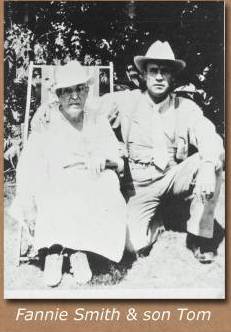
SARAH FRANCES BUCKHANAN SMITH (1864-1937)


Sarah Frances Buckhanan, my husband’s great-grandmother on his mother’s side, was born on January 1, 1864 in Bentonville, Benton County, Arkansas. What a frightening world surrounded her. The Civil War was waning but in northwestern Arkansas the Confederates, bushwackers, and Native Americans fought off Union troops who regularly ventured into Benton and Washington counties, engaging in bloody skirmishes, leaving behind bodies of locals and burnt remains of their homes. Arkansas, much like Missouri, was divided in its allegiance to either the Union or Confederate armies and fought the war internally for four long years, sacrificing thousands of men, more than a few women and children, and many buildings that housed county records, stores of food, and homes.

Sarah’s parents were John Littleton Trout Buckhanan and Elender Jane Keeling Buckhanan. Sarah was the fourth of five children born to Elender before her death at a young age, approximately thirty. Those records that were lost in the Civil War have made tracing Elender’s life a bit difficult but we believe she was born in Roane County, Tennessee between 1837 and 1838 and died between 1866 and 1870. Her burial place is unknown. She left behind five children, Mary Jane born in 1857, Margaret in 1859, John Montgomery (named after his paternal grandfather) in 1860, Sarah Frances in 1864, and George Thomas in 1866. It may well have been the birth of her last son, George, in Missouri that took the life of Elender, and perhaps her body rests there, but that is only a guess.

John Littleton Trout Buckhanan’s beginnings are not easily traced with at least one record showing him as having been born in Missouri, another Sadler, Texas, and most likely Madison County, Arkansas. His parents were John Montgomery Buckhanan and Catherine Airhart Buckhanan, both of Tennessee. Not long after his wife Elender died John L. T. married Margaret A. Copinger McGowan in St. Paul, Madison County, Arkansas. She became mother to his five children, brought to the family five children of her own from a previous marriage, and birthed three more, Harvey Henry in 1870, Hannah Tennessee in 1873, and Sherman in 1880.

In 1894, having lived in Texas for years, John was back in Madison County, Arkansas where he married his third wife, all Tennessee born. Her name was Mary Elizabeth Ferrell. On August 22, 1907, John died in Whitesboro, Grayson County, Texas at the age of seventy-three. Mary lived until May 9, 1934, and died in Gibtown, Jack County, Texas.

Back to little Sarah, known to her family as both Frances and Fannie, only a toddler when her mother died, life continued to be full of turmoil and upheaval.  At the time of the 1870 Federal Census her father’s occupation is farmer in Madison Co., Arkansas, with ten children in the household. Ten years later he is listed as a farmer in Grayson Co., Texas, with five children in the household. The Federal Census for 1890 was destroyed in a fire so we don’t know where the family was then. In 1900, John and his wife of six years, Mary Elizabeth, are living in Grayson Co, Texas with only their eighteen-year-old grandson Selmer, son of Margaret Buckhanan.

Meanwhile, Fannie married William Franklin Smith on December 24, 1887 in Grayson County, Texas when she was twenty-three. The fact Fannie didn’t marry at fifteen, sixteen, or seventeen like so many girls of the times was probably because she was needed at home to help with the younger children. Fannie’s granddaughter Rosa Ellen Fairchild Farrell wrote in her memoir this about her grandmother, “Frances Buchanan’s mother was taken from her small family while Frances was quite young. But, like the trooper she was, Frances took her mother’s place the best she could. She was a tall, slender girl with black hair, brown eyes, and high cheek bones like those of an Indian. Her mouth was set in a firm line. Because she was a cousin of Frank Smith, her ancestors were also Irish, English, and Indian. Her father was a soldier in the Civil War, later he was a cattle owner and rancher in Texas. As children, Frank and Frances were playmates; as older children, they were pals; as adults they were sweethearts. When the Buchanan children were old enough to get along without Frances, she and Frank were married.”

As Rosa Ellen mentioned, Fannie and Frank were cousins, but not quite first cousins. Frank Smith’s maternal grandmother, Elizabeth Jane Buckhanan, was a sister to Fannie’s father, John Littleton Trout Buckhanan. I think that makes Fannie and Frank first cousins once removed. We’ve all heard the admonition “don’t marry your cousin.” In this case that advice should have been heeded for it seems the Buckhanans carry a gene for hearing loss, an unusual nerve deafness known as DFNA/DFNA1 hereditary hearing loss, which has continued to manifest itself in at least six subsequent generations of descendants.

Married in Grayson County Texas on Christmas Eve, 1887, Fannie and Frank moved on to Oklahoma where in 1893 they staked a homestead claim near Noble. By 1908 they sold out and followed the urging of a relative, R. E. Morris, to try their luck in the rugged mountains and valleys of Moffat County, Colorado. They packed up their meager belongings and with their family of five children moved to Bear Valley, north and west of Craig, Colorado where the railroad ended and some of their lives ended too.

I wish I could say Fannie’s life got better after her marriage and maybe for a little while it did. But when I look at the photos of the family with beautiful children who died soon after the photo was taken I see pain and hardship there. 


Their first born child, Thomas Alvin Smith, born in 1889, did live a good, long life, to age seventy-one, and he is my husband’s grandfather, my husband being Robert Doyle Russell.

The second born, William Lee, born in 1890 died within a year.(He in not in the photo to the left as he had already passed away.)

James Wesley Smith, born in 1894, was murdered at the young age of twenty-eight, the same day his father was also murdered, both over a dispute with a neighbor about a potato crop. More about that tragedy later in this story.

Their fourth son, Bennie H. was born in 1895 and died when he was eight.

Their fifth child was a daughter, Lillian Vernatta, born in 1897, lived to be seventy-four.

Ernest Franklin was born in 1902 and lived to be seventy-eight.

Rosa Jeanetta was born in 1905 and lived to be seventy-seven.

Ola Mae was born in 1906 and died three years later.

Julia Ellen was born in 1908 and lived to be seventy-five.

Of the nine babies she birthed, Fannie lost four of them, and she had a stroke at age forty-four, upon the birth of her last child, Julia. No wonder that final horrific blow to her well-being that came on October 5, 1921 when both her husband, William Franklin “Frank” Smith, and her son James Wesley “Jim” Smith were shot and killed not far from their home, sent Fannie into a tailspin, brought on another stroke and took the zest for living right out of her. She stayed in Bear Valley two more years after their deaths before she had enough money saved to retreat to the more civilized city of Oklahoma City where she lived with her daughter Lillie until the end of her life in April of 1937.

There was another tragedy in Bear Valley that affected Fannie and that was the death of her daughter-in-law, Nora Olive Jones Smith, the wife of Fannie and Frank’s oldest son, Tom.
Nora died in Craig, Colorado where she had gone to await the birth of her fourth child. Their daughter Jennie Frances Smith was born September 12, 1918 and six weeks later Nora succumbed to the virulent Flu Epidemic of 1918 that was sweeping the nation, indeed the world. Fannie and Frank took
newborn Jennie Frances, always called Frances by her family, into their home where she lived until at the age of three when her Grandpa Smith and Uncle Jim were killed. By that time Tom had remarried and Frances joined their household, not far from the home of her grandparents. Her grandmother, Fannie Smith, not only suffered the loss of her husband and son, but had to give up parenting her granddaughter and namesake, Frances Smith.

As for Fannie’s health at the time of her husband’s and son’s deaths, her granddaughter Rosa Ellen had this to say, “(Rosa Ellen has been describing the events of the day when her grandfather Frank and his son, Jim, were shot to death, from the perspective of her mother, Rosa Smith)……From her bed, Frank’s wife jumped! For days she had lain there recovering from a stroke. Her daughters tried to hold her back, but it was useless. The instinct of a wife and mother told her that Death had struck. Half way to the pasture she collapsed, from fatigue and another stroke. The girls ran to their mother and carried her to the house and put her to bed once more. Neighbor women came to help in every possible way, as soon as they heard of the tragedy. Hearts that are broken never completely heal. Mrs. Smith lay in bed for weeks, unable to move. Her thoughts were of the days she had known as Frank’s wife and Jim’s mother.”

Fannie and Frank’s older daughter Lillian Vernetta “Lillie” Smith Williams traveled from Oklahoma to Colorado to attend the funeral of her father and brother, and stayed awhile longer to care for her mother before returning to Oklahoma and her husband Floyd Williams. Nearly two years later Fannie told her family she could not spend another winter in Colorado so her newly married daughter Rosa and husband, Art Fairchild, drove Fannie and daughter Julie out of Bear Valley and down to Oklahoma City to live with Lillie. (One account says she took a train to Oklahoma.) The following year Tom Smith left the valley for good, ending the era of the Smith family in Moffat County (see http://www.viewoftherockies.com/CraigtoPurcell1.html for photos of that infamous trip across the Continental Divide)

Apparently Fannie’s health improved in Oklahoma for she traveled north in the summertime on several occasions to visit her family in Colorado. Frances Smith Russell wrote in her autobiography “From There to Here” about her grandmother “Grandma Smith would visit us during the summer.  She said she just couldn't take the summer heat in Oklahoma.  She divided her time between our house, and Daddy's sister Rosie, and brother Earnest.

Her visits were truly the happiest times of my life.  She still had a soft spot for me and could find a lot of little things to delight me.  She insisted on helping me with the dishes.  That was a real treat.  Since the older kids were kept busy in the fields, the washing and drying dishes was my job.  One summer while she was visiting, she and Ma pieced me a quilt top out of Mother's clothing.”

And later in her book Frances wrote this about her Grandmother Smith, “We went to Oklahoma to visit Grandma in August of 1936 (paraphrased). Grandma lived with Aunt Lillie and Uncle Floyd (Lillie’s second husband).  She had made her home with them ever since Grandpa and Uncle Jim were killed, and she moved back to Oklahoma.  She had two strokes and was partially paralyzed.  She was quite feeble and spent most of her time in her easy chair.”

And this, “In April 1937 Grandma Smith died.  I was so glad I had gone to see her the summer before.  She still lived with Aunt Lillie.”

Rosa Ellen wrote this of her Grandma Smith’s passing, “Mother went to Oklahoma at Thanksgiving (1936) to visit her sisters and brother, and her mother, who was ill. A few days after arriving at my aunt’s home in Oklahoma City, Jackie (Rosa Ellen’s half brother) became ill with diphtheria. Only because of the fine surgical care was he saved. When Mother returned to Pierce (Colorado) during the Christmas holidays, she was nearly sick because of the continuous care she had giving Jackie. In the spring a telegram came during dinnertime. Grandma had gone to join Grandpa and her three children in Heaven. This news was extremely hard for Mother to bear.”

One more firsthand source of information about Fannie’s later years comes from a letter written by Betty Jo Barton Gaston, the daughter of Fannie’s youngest child, Julia. The letter was addressed to Rosa Ellen Fairchild Farrell, Betty’s cousin…date of letter unknown. These are excerpts from that letter: “But let's back up a bit. Frank and Fannie had got land in Oklahoma, (the land run), up by Noble, OK. (April 2, 1889) While there they lost 3 children---they are buried there and that's where both Granny and Aunty are buried. (Granny is Fannie. Aunty is Frank and Sarah's daughter, Lillian). Those 3 children were Bennie, Lee, and an Ola. One of the boys was crippled somehow and in Granny's trunk of keepsakes was little shoe with a brace on it that he had worn.

“We loved for Granny to look through her trunk and tell us the stories of each thing in the trunk. She usually cried---and I could never figure out if seeing the things made her cry or if she had just got the blues real bad and then got out the stuff.

“One thing was a rock---not too big---and she said one of those boys who had died had been sitting in the yard crying, and when Pa came close he told Pa that he was mad at Ma. Then Frank told him: "Well, if I was you, then, I'd just kill her." So the little guy picked up this rock and went in and threw it at Granny. When she would tell that she would laugh and blow snuff all over us---if we didn't watch out!

I guess Mother (Julia) was born at Noble, and at that time, Aunty (Lillian) would have been 10 or 11. That's when Mother told me that Granny had the stroke (at the time of Julia’s birth). Aunty said after Granny had the stroke she had to start doing all the cooking, washing, and etc.

“Then they told me the family moved on to the Weatherford area, and that is where Aunty (Lillian) met and married Floyd Williams. Then from there they went to a ranch on White River. We visited the ranch site and the schoolhouse that was up then. From there they moved on to Moffat County where the guys were shot.

“Mother (Julia) told me that Granny explained to her that they couldn't stay another winter out there with no men---so they each packed a trunk and they rode the train back to Butler, Oklahoma, where Aunty and Uncle (Lillian & Floyd) lived. She never mentioned who paid for the rail tickets. She didn't mention Rosa coming with them. She did say that Granny told her that maybe they could go back when it was spring.

“When I was about 9 or 10 I had the mumps and Granny was at our house. She said "I'll sleep with Betty and take care of her. I've nursed mumps all my life and never had them, so guess I'm immune." But she sure WASN'T! In due time she did have the mumps and from then on her health went down and down. The strokes started coming back on her---
and she died the same spring that Tilford was born in 1937.

“Granny always lived with Aunty (Lillian) from the time they came from Colorado. She'd visit us once in a while, and I think she traveled to Colorado to see her other children a few times---but not very many times.

Sarah Frances Buckhanan Smith died in April 11, 1937 at the age of 73, and was buried in the Maguire-Fairview Cemetery near Noble, Oklahoma. She left many descendants, a proud family of Smiths who have thrived and multiplied - Fannie would be proud.

NOTES: 
1) The name Buckhanan has been spelled various ways and today is usually spelled Buchanan.


Saturday, March 14, 2015

Robert Sidney Russell - Uncle Sid

I asked my sister-in-law, Mary Simms, to tell me what she remembers about her Uncle Sid, thinking I would incorporate her memories into a story of my own, but when I read what she wrote I realized I could not improve on it. Therefore, this is Mary's story.

A NIECE REMEMBERS SIDNEY RUSSELL

[This memoir will be divided up into segments showing the origin of the information.]

MARY RUSSELL SIMMS:

I first met Uncle Sid when he came to Colorado to spend time with Frances and Doyle at the end of World War II.  He had recently been discharged from the US Army after seeing combat duty in the Pacific Theatre.  Sid had been wounded quite seriously and was still in a state of post traumatic shock from war injuries.  Later I felt it was rather unusual that upon being discharged that Sid came straight to Doyle in Colorado rather than returning to Arkansas to be with his parents first.

Uncle Sid was a very quiet and polite person and showed great respect to everyone he met.  Sid had a personality that people just automatically gravitated toward.  A truly magnetic personality.  Especially attracted to Sid’s charisma were the ladies—both married and single.

Sid had very little money and most of the time did not have wheels of his own, so he mostly dated women who had access to a car and could provide their transportation.  He did eventually purchase an old c1928 beet truck that ran at times and did not at other times.  One night while en route to see one of his harem of lady friends his truck lights gave out all of a sudden.  Since all roads around Nunn, CO were built on the straight surveyed section lines, Sid assumed he could simply continue in a straight course until he came to a stop.  Not so.  Seems now and then the intersections of the county roads had a jog in them, and when passing through the intersection one came out about 50 feet to the left or right when entering the next mile of road.  [The reason for this jog was said to be because the earth is round.]  Unfortunately, it was at this point when Sid’s lights gave out—just before the jog.  He and his old truck ended up in the ditch just to the left of the continuing county road—with the front of the truck nosed down into the road ditch and the radiator slammed up against the ditch bank on the far side.

One lady that he courted for quite a while was a local school teacher named Miss Marita Plunkett.  She was especially nice but did not have access to a car of her own.  Hence Uncle Sid did not spend too much quality time with her.  When he would return from a date with Miss Plunkett he would drop his used condoms at the yard gate.  Frances would go out the next morning and dig a hole and bury the offending items so her kids would not find them.

One time Miss Plunkett and Sid came by the house and came in to visit for  a while before going off on their date.  Our family had spent the day shopping in Greeley.  Unfortunately when Kenneth was sent back to close the kitchen door that he had left wide open an old hen had already wandered into the kitchen.  Kenneth did not notice the chicken and slammed the door shut.  Several hours later when Doyle and family returned from Greeley, the hen had spent her time roosting on the cot in the living room and doing as all good hens do—pooping on the bed.  Frances chased the hen out but failed to check for damages. 

Bobby and I were already in bed on the cot when Sid and Miss Plunkett arrived so Miss Plunkett, being a very mannerly person, came into the living room to say hello to Bobby and me.  She sat down on the foot of the bed and leaned over with her hand resting on the covers.  It was rather dark in the room and Miss Plunkett kept sniffing at the air and trying to hold a straight face.  The next morning was when Frances found that the bed covers were covered with chicken poop!   We never did find out if Miss Plunkett got any on her skirt or hand—but judging from her continuous sniffing the air she had to have smelled the chicken poop.  Frances was mortified!

When a lady would tell Sid that she was married and hands off, Sid would inform the lady that she was much too pretty to be married, and the lady would usually have an affair with Sid.  Flattery will get you everywhere. 

One morning Sid was still asleep in the “north” bedroom when Frances told Kenneth and me to come see something.  Sid was facing toward the wall and the covers had come down to his waist and his entire bare back was exposed.  I could not believe what Sid’s back looked like.  His entire back was one huge scar from burning.  Seems he had been scalded by a boiling teakettle when he was a kid and then again by a mortar shell during the war.  He must have suffered terribly from those injuries.

Uncle Sid related this incident about the war injury to our family himself.   For a long time after he was wounded in battle, Sid was totally helpless.  They kept him strapped down to the bed to keep him still while he healed.  For some reason Sid was kept totally naked during this time.  Perhaps to expedite healing.  Anyway, he said that one day a new nurse came in and whisked back the covers in preparing to change the sheets.  When the covers came off there lay a totally naked man bound hand and foot to the hospital bed.  For some reason this amused the nurse and she burst out laughing and ran out and brought in several other nurses who stood around and laughed and giggled about Sid’s condition.  This really upset Sid. 

Our house was very small and there were six in the family.  We had only two bedrooms so it rather crowded us to have Sid taking up one entire bedroom.  Doyle kept finding Sid a place to live with neighbors to free up our living space a little.  One place Doyle found was with a rather dishonest bachelor fellow named Mr. Quaif.  He and Sid seemed to get along OK and Sid stayed there for quite a while.  Mr. Quaif had a car and I would imagine he let Sid use it to court the ladies.

Uncle Sid was always very nice to Doyle’s kids.  He would bring us candy and other treats from town.  He once gave me a small cedar box that he had won on the local punch board.  It had originally been filled with Hershey Bars which he very generously shared with the entire family.  I was so thrilled when he gave me that beautiful carved cedar box.  It was about the 6” by 10” and 3” deep. 

Another local family that Sid lived with was Hattie and Everett Wilson.  Everett worked for Murray Giffin and when Sid went to work for Murray, it just seemed logical for Sid to get board and room from Hattie and Everett.  They thought the world of Sid as did about everyone he encountered.  One time Sid’s shoe string broke and he bent over and tied the two broken ends back together.  This act shocked the Wilsons no end.  They always threw broken things away and replaced them with new things.

Uncle Sid eventually returned to Arkansas to live with his parents for several years before he finally go married and moved in with his new wife.  Sid was given a partial disability pension from the war injuries.  Not enough to live on as a normal person but enough to live like a bum.  I saw Sidney in 1950 and again in 1958 when I visited Addie and Elias’s home.  He was very quiet, and stood on the front porch most of the time smoking a cigarette.  He was a kind and gentle person.  

FRANCES RUSSELL

Bobby always looked more like his Uncle Sid than he did his Papa Doyle.  This eventually gave rise to a questioning of Bobby’s paternity.  One person came right out and told Frances that it was quite obvious that Frances had had an affair with Sid and Bobby was Sid’s son.  Fortunately, for Frances’s reputation, Frances and Sid had never met until after Gladys was born so that squashed the rumor quite quickly.  The accuser was Uncle Harold’s wife, Shirley.  This really ticked Frances off.


SID’S MOTHER

Sid was in active combat in New Guinea during World War II and got wounded very seriously.  Seems the natives would steal the dead soldier’s dog tags and sell them to the Army to account for mortalities.  Sid got a bit too close to a mortar shell and was assumed dead by the Natives who removed his dog tag and turned it in.  The Army forthwith informed Addie and Elias that their son had been killed during a battle in New Guinea.  They also sent all of Sid’s personal effects back to his parents.  When the medics checked the battlefield for survivors they found Sid nearly dead.  He was transported back to the Army hospital and was unconscious for a long period of time.  It was touch and go during this time.  When Sid finally came out of his coma he had no idea who he was or where he was.  His memory was blanked out from the trauma. 

When the day came that Uncle Sidney finally remembered who he was and told his doctor, they wrote to his parents and told them that their reported dead son was actually alive but in serious condition at an Army hospital in the South Pacific. This must have been quite a shock to his parents.

It took a long time after this before Sid could leave the hospital and be discharged and return to the US.  

When Sid was just a little kid, he and his siblings were running through the house like a bunch of wild Indians when Sid got too close to the fireplace and caught his toe in the teakettle filled with boiling water.  He flung it all over himself and  scarred quite a bit of his body.  The burns were quite serious but Addie doctored him through this.

One day Hazel came running up the path between Seldon’s house and Addie’s house all excited.  She yelled to Addie that Sid and Minnie had just got married!  Hazel was quite thrilled.  Addie was furious.  She did not like Hazel and disliked Minnie even more.  It was at this point that Sid finally moved out of his parent’s house and moved into Ozark to live with his new wife.

Robert Sidney Russell (1916-1977).

Sunday, January 18, 2015

UNCLE SELDON


Theron Seldon Russell was born October 27, 1921, in Cass, Franklin County, Arkansas, the eleventh child of Elias L. and Addie Jane Russell. I don’t imagine that Seldon, as he was called, got a lot of individual attention from either of his parents with that many children in the house but he had plenty of older brothers and sisters to look after him. He was born at home, birthed with the help of his father’s mother, Mariah Tennessee Turner Russell, who was midwife for all of Addie Jane’s children, and named them too! His older brother Doyle J. Russell, my husband’s father, told me that his baby brother was named after a local school teacher named Theron. I don’t know where the Seldon came from. There would be one more child born to Elias and Addie Jane, another boy they named Harold who came along three years later in July of 1924.
I know very little about Seldon’s childhood but assume it was much like that of that of his seven brothers with hard work, few toys, and lots of wooded areas to explore along the Mulberry River and the tree covered, rocky hills surrounding Cass.

From one of Seldon’s cousins, Herbert Reid, we learned that Seldon loved theater and performed in several plays when he was a school boy in Cass. All his life he liked to make things with his hands using simple tools like the pocket knives his older brothers whittled with. Late in life he was still making wooden chairs and re-caning the seats. On one of his visits out to Colorado to visit Doyle, Seldon brought his nephew Bobby a door knocker made from a horseshoe. It still hangs on our front door and is used often, reminding us always of Uncle Seldon....it is cherished.

But I’m getting ahead of myself….On October 20, 1942, Seldon enlisted in the Army Air Corps at Little Rock, Arkansas. He was a single, twenty-one year old with two years of high school education and some experience driving a bus or truck. He was 5’7” and weighed 134 pounds, and enlisted for “the duration of the war plus six months at the discretion of the President.” Seldon served his country honorably and came home to Ozark after the war along with six of his brothers who also served in the military in WWII, a proud family tradition of service to our country.


On April 6, 1948, Seldon married Mary Hazel Wisdom in Paris, Arkansas. Ten months later they welcomed their first child, and only boy, into the world, Theron Jimmy Russell. Seldon and Hazel lived in a little white house within shouting distance of his parents and proceeded to raise a family, Seldon working for the Forest Service, a very good job for that time and place. Six lovely daughters were born to them from 1951 to 1965,  Mary Sue, Patricia Joyce, Nancy June, Brenda Kay, Judy Ann, and Teresa Diane. Hazel’s health was not good and she passed away in April of 1982, just a couple of weeks before their youngest daughter was married.

Two years later Seldon remarried, a local woman named Mary Emily Wright Primm, formerly of Claremore, Oklahoma. They had twenty-three years of life together, happy years, from all outward appearances, before Mary passed in 2007 with Seldon following a year later. Several times during those twenty-three years Mary and Seldon drove out to Colorado to visit Doyle and his family, including the celebration of Doyle and Frances' golden wedding anniversary in 1985. 


Bob and I remember Seldon as a friendly, kind, thoughtful Uncle and only wish we had known him better, had visited him on his own turf, learned what made him most happy in life. He’s left a legacy in his children and grandchildren and in the handcrafted items he made with his own hands.

Saturday, October 11, 2014

TURNER BEND; A Community Full of History

(reprinted from the Arkansas Gazette, 1969, by Shirley Curtis) Turner Bend, near Cass up in the Ozarks, got its name for a couple of obvious reasons: It is named for a family named Turner and it is situated on a bend in the Mulberry River.
Here Champ and Flora Turner daily ply their trade – the operation of a grocery store-service station combination. Seven days a week one or both of them help the numerous people who stop, lending credit to old customers, making friends with the new ones. The Turner family has lived in this valley for 120 years. It was in 1849 that Elias Turner and his wife Sarah made their way from Tennessee to Arkansas and fell in love with this promising area. The fertile land, majestic mountains, the swift-moving clear creek that cut its way down the center of the valley could hardly be overlooked, and they probably arrived in the springtime when the woods were blossoming with greenery that deepened as the months progressed to summer and later turned to brilliant hues of red, gold, and brown in the autumn. Here they were to work the land, rear eight children, and live for the rest of their lives.
Elias Turner was born in 1821 in Perry County, Tennessee; Sarah (Durning) in 1815. Little is known about them until they reached Arkansas in the mid-19th Century. At this time Elias contracted to buy 500 acres between Cass and Ozark for $2 per acre. He and his wife settled on the land, and it wasn’t long until they acquired many new friends, one of them a neighborhood school teacher. Elias confided in his new friend that he had $1,000 with which he was going to purchase the 500 acres. And before too much time had elapsed, the teacher stopped by the Turner house when he knew Elias was away for the day and Sarah was down at the creek washing clothes. Although he had not been told where the money was hidden, it didn’t take him long to find it tucked away in a walnut chest the Turners had brought with them from Tennessee. He took the money and skipped the country, never to be found. The $1,000 was lost forever, but the Turners were still obligated to buy the land because they had signed a contract. Somehow, over the years, Elias managed to pay his debt and the land became his, later to be handed down to his heirs. When the Civil War broke out in 1861, the Turners were true to the Confederacy. As Union troops eventually edged through Arkansas, Elias preserved food for his family by storing corn in the logs of the cabin where pilfering soldiers and renegades could not find it. (These same logs are still intact today, covered with siding but nevertheless comprising one room of the house near Cass.) As the war progressed and soldiers were desperately needed, Elias joined the Southern army, fighting in both Arkansas and Texas and rising to the rank of captain.
Samuel Turner, Elias’ son, also served with the Confederacy, in the 23rd Texas Calvary. In 1862, at the age of 20, he married Phoebe Marsh, a midwife who was to deliver most of the babies born in the area during her lifetime. (ed: Samuel Turner was brother to Mariah Tennessee Turner who was Doyle J. Russell’s beloved grandmother.) Clearing land for a homesite proved to be almost more than Samuel could handle, but as the sky grew dark and the air became heavy one day, he continued to work. By the time he realized a tornado was descending upon him, it was too late to find safe cover. Throwing himself to the ground, he locked his arms as tightly as possible around the tree, but the lashing wind was so strong that it literally bounced him and the tree up and down. Incredible as it may sound, he escaped unhurt – and built a home.
In 1892 Samuel built another house, a handsome two-story log structure that still stands today. (It is now owned by Mr. and Mrs. Joseph Berterotti.) The hand-hewn logs have since been painted red, as striking contrast to the white mortar which holds them together. The tall, natural stone fireplace he pieced together with rocks gathered from his hillside. It was this same year that Samuel and Phoebe entertained the James Brothers – Jesse, Frank, Bob, and Cole Younger made up the party that spent the night with the Turners. As the adults settled down to talk, one of the gang poured out a sack of money on the floor so the children could play with it. (Incidentally, whether the family actually wanted to entertain the notorious outlaws is what the lawyers would call a moot point. Quite possibly they had no choice in the matter.) Phoebe Turner, as well as her family, was unique person. She smoked a clay pipe (which the Turners still have), using a small piece of cane for the stem. Whenever she was ready for a smoke, or a chew, up went the long skirt as her hand reached for the pouch of tobacco and the pipe carried in a handy pocket in her petticoat. Usually she chewed awhile before smoking. Phoebe’s mother was a fearless woman. Like most people in the 1800s, she raised hogs, and inasmuch as this was a time when animal predators roamed widely through the Ozark hills, she trained the hogs to run to the house when wolves got after them. Upon hearing the hogs squealing one day, she quickly let them into the house and barred the door, but not before she had caught a glimpse of the large black bear in hot pursuit. Determined to make a meal on the swine – if not her - it lunged against the door again and again. Growling and clawing, it angrily even tried to dig under it. The bear was making progress when Phoebe’s mother grabbed an axe and with one blow severed a paw from its body. But it was not until after the animal had climbed onto the roof and torn off several boards that it gave up and lumbered off into the woods to nurse its wounds. Phoebe’s brother, Jim Marsh, risked his life during the Civil War to protect his neighbors. As bushwhackers began to straggle through the community, stealing and plundering as they went, Jim built himself a fort of rock near the road. Darkness one night found him hidden behind his shield with plenty of ammunition but only one gun. The bushwhackers came, a few at a time, only to meet their deaths. Before the night was over, Jim had killed nine. Phoebe and other neighbor women buried soldiers whenever it was necessary, once putting away a dozen or more Confederates who had been ambushed in their camp. No one knows who they were or where they came from, but the stone markers the women placed on their graves are still visible on a hillside overlooking the Ozark Frontier Trail.
The next descendant in the line of Turners was William Eli, Champ’s father, who not only farmed and ran the store for awhile, but also made coffins for people who could not buy one. Eli had a total of 24 children, an even dozen by each of his two wives. Eighteen of them are still living (1969), and it is no small wonder that they now keep in touch with each other through their own newspaper, The Turner Tattler, published by members of the family living in Texas. Six of Eli’s sons were in World War II at the same time and all came back alive. Champ, stationed with the 84th Infantry, was engaged in the action of the Battle of the Bulge in addition to other major battles, but safely returned to his wife, Flora, whom he had married in 1939, and his business. Home at last, Champ was in the familiar surroundings he had known all his life. Champ remembers his early days at Turner Bend when toys were scarce and the whole outdoors was his playground. With his friends he spent many memorable hours swimming, hunting, fishing, and exploring the intriguing caves scattered around the hills. When he wanted to visit someone, and the distance was too far to walk, he rode an ox. In fact, he road an ox to call on his first girl friend. But the time for play and adventure was little, for there were chores to be done, land to be farmed, and livestock to feed. Leisure time was so precious that not one minute could be lost. Perhaps this is why children found so much to do during their free moments. As a boy Champ learned that a turtle’s shell becomes a dandy soap dish after it is scrubbed, and a limb from a sweet gum tree makes an excellent toothbrush. You simply cut the limb at the notch, peel back the bark, and chew the fibers until they bush out. Today Champ and Flora are two of the few Turners left around Cass. Only one of their sons, Paul, remains at home. Gary is assistant manager of a restaurant in Fort Smith, and Lonnie is a law student at the University of Arkansas. Champ’s Uncle Gilbert, the oldest living member of the Turner family, lives in Fort Smith, but returns whenever possible for a visit. A spry man of 89, he just recently sold a three-wheeled motor scooter which he bought four years ago. When the purchaser couldn’t pick it up, he promptly hopped on the scooter and delivered it from Fort Smith to Van Buren. Gilbert remembers the days when his mother, Phoebe, and his grandmother Sarah labored from dawn to dusk canning fruits and vegetables, spinning cloth and making clothes for the entire family, and curing meat for the long winter ahead. Gilbert recalls the night the James Brothers came to his father’s house, but the thing that impressed him most was, “They didn’t think any more about us kids playing with that sack of money than anything.” Except for modern conveniences and a paved highway, Turner Bend looks much as it did in the old days. Champ and Flora have retained many of the family heirlooms, such as a powder horn that belonged to Elias, cotton cards to make bats for quilts, a shoe last for mending shoes, and a tooth extractor used in the days when the man of house was also the dentist. Their large mantle clock, dating back to 1825, came from Belgium and was made by a soldier serving under Napoleon when Belgium was reunited with France. While wild animals are rather rare in the area, they are by no means nonexistent. Occasionally someone still tells about seeing a panther or a mountain lion, and armadillos and roadrunners, which have started migrating up from Texas, are seen frequently. Tourists traveling the Ozarks on Highway 23 find Turner Bend a natural stopping place, and the Turners readily give them any information needed to make their journey more pleasant. However, they do lose a potential customer once in a while before he ever enters the store. Some people take offense at being greeted by a long, loud wolf whistle, and this is exactly what happens to every one who stops. The explanation is simple. The Turners have a Mynah bird who never misses an opportunity to pull this mischievous antic. But it is a little unnerving to the unsuspecting tourist who opens his car door and thinks someone inside is whistling at him or his wife, as the case may be. Some merely close the door and drive away. The Turner family has found peace and tranquility in this beautiful valley since 1849. No one can venture a guess as to how long Turners will live in it, but undoubtedly the love first felt by Elias Turner for the land has endured in the hearts of each generation.

Tuesday, July 1, 2014

Nora Olive Jones Smith - Our Link to mtEve

I've been doing some reading about Mitochondrial DNA, a unique part of the human genetic makeup that is only passed from mother to daughter. My interest was piqued when I had my own DNA tested through the National Geographic Genome project, and being female, my mitochondrial DNA is the line I now have most knowledge about. But all that is only important in this blog to explain why I am thinking about genealogy, genetics, and our Smith/Jones family line.
Nora Olive Jones, the fourth of thirteen children born to James Archibald Jones and Eliza Jane Holcroft Jones, married her longtime neighbor become boyfriend, Thomas Alvin Smith, on August 24, 1910, at the Jones family home in Weatherford, Oklahoma. It was Tom Smith's 21st birthday; Nora was seventeen. Their first child, Ola Mae Smith, was born a year later on August 10, 1911. A son James Franklin Smith followed on May 11, 1913, and a second son, Oliver Thomas Smith, on June 30, 1915. Nora's short life ended on October 23, 1918 in Craig, Colorado, where she had just given birth to her second daughter, Jennie Frances Russell on September 12, 1918. The childbirth weakened her and the Spanish Flu Epidemic of 1918 took her life. A rift occurred between the Smith and Jones families after Nora's death, specifically, Nora's mother blamed Tom Smith for taking her daughter to that God-forsaken land northwest of Craig, Colorado, and letting her die there, far from her Oklahoma family. Eliza Jane had lost her husband in 1917 so the death of her daughter a year later was particularly cruel. Because the families were estranged Jennie Frances Smith, or Frances as she was called, grew up with scant knowledge of her Jones relatives. It was only as an adult that she made contact with uncles and aunts, learned a little about the mother she never knew. Frances did pass along to us, her children and in-laws, a bit of the history of the Jones family and a few personal stories about her mother but not nearly enough for us to know what Nora was like. Instead we are left with a few sad photographs of an over-worked woman living in a small log house on the sagebrush covered plains of Bare Valley, Colorado. But she left two daughters, Ola Mae and Jennie Frances, and those daughters had daughters and granddaughters and so Nora Smith's mitochondrial DNA lives in the cells of those granddaughters and gr-granddaughters today. Ruth and Emily can trace their mtDNA from their mothers, Nora and Cyndee, to their maternal grandmothers, Irene and Gladys, to their maternal gr-grandmothers Ola and Frances, to Nora. Nora's line continues back through time through her mother, Eliza Jane Holcroft, through Martha B. Robbins in the early 1800s and beyond. Current genetic theory traces us all back to one woman living in Africa about 140,000 years ago, nicknamed Eve, not the Eve of the Bible but the Mitochondrial Eve. As I understand it, the mitochondria is not responsible for traits like hair and skin color or shape of our eyes. In fact, scientists are not sure what traits are passed through the mitochondria but it's a fantastic tool for tracing our ancestry through our mothers. It has been used by geneticists to establish migration routes and time frames. Nora Olive Jones Smith had a short and difficult life but her contribution to our family was significant and her genes live on.

Monday, June 23, 2014

Our Smith Family is Better Known to Us Now

In 2007 Mary Russell Simms, daughter of Doyle Russell and Frances Smith Russell, decided she wanted to host a gathering of her mother's family, the William Franklin Smith descendants. Aware that a few of the Colorado-based Smiths were meeting each summer in Windsor, Colorado, she wanted to expand on that to include all the far-flung relatives across the nation. That huge effort culminated in a family reunion held near Oklahoma City mid-September 2008. Sixty-two attendees made the gathering a wonderful success with cousins united after years of separation. Thanks to Mary's searching out distant kin there were cousins there who had never met one another.
Each year after that Mary coordinated reunions of her Smith family, the most ambitious of which was a gathering in Moffat County, Colorado to visit the home sites in Bear Valley, northwest of Craig, where the Smith family lived in the early 1900s, where Grandpa and Uncle Jim, aka William Franklin Smith and his son James Wesley Smith, were murdered, and where Mary's own grandmother, Nora Jones Smith succumbed to the Spanish Flu of 1918. Only one reunion had to be cancelled and that was last year, 2013, when tornadoes lay waste to areas around Oklahoma City.
This year's reunion is now history. Mary accomplished her goal of erecting a sign on the land her gr-grandfather homesteaded near Noble, Oklahoma in 1894. The attendance this year was very small, an indication that interest has waned, old age has taken its toll, and the bad economy is affecting us all. But we can all be thankful to Mary for bringing us together again, the descendants of William Franklin Smith and his brother John Alvin Smith, for teaching us about their lives and our connection to them. We now know that we are a hardy bunch, healthy, good looking, and prosperous. But we do share a hereditary hearing loss and Mary researched that too, encouraging all family members to share their audiology profiles which culminated in Mary's book "The Smith Family Curse."
I would personally like to thank Mary for all the hard work she put into this study of her mother's family, for bringing us together year after year, and for accomplishing her goals of posting permanent markers on the land and publishing the results of the hearing loss study. Thank you, Mary. You persisted where others would have given up years ago. Great job!