Tuesday, December 31, 2013

Elias Russell Home Remodeled by Cowan Family in 1991

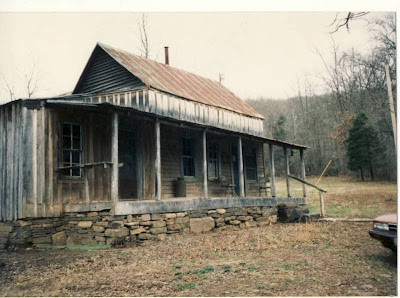
Elias Russell homestead

(photo above taken by Kenneth Russell during his visit there in 1994)
Elias Russell and his wife Addie Jane Mahaffey Russell lived their entire married lives in the house he built near Cass, Arkansas about 1901. I could be off a few years on that date as he may have started the house before he married Addie Jane on September 22, 1900. They reared twelve children there and after Elias died January 19, 1960, Addie continued to live in the house for a few more years before their oldest daughter, Bertie Lee Russell, insisted her mother move to town, a move that Addie was very much against. Addie died December 7, 1970, and I hope she was able to visit her old home often, but I don't know that for sure.
In 1991 the new owners of the property, Bernice and Curtis Cowan, restored all six of the buildings on the place. Elias and Addie's son, Seldon Russell, who lived nearby, visited the property with one of his daughters, Teresa, and took photographs of the buildings in their restored state. He also made a video of his visit, explaining as he walked around how each building was used by his parents. I have posted those photographs on a webpage here http://www.viewoftherockies.com/cass1.html
Seldon passed away in April of 2008 and I believe the Cowans are gone now too. As I write this in 2013 I don't know who currently owns the old Elias Russell place or what condition it is in but I'm eternally grateful to Uncle Seldon for sharing his photographs of the restored homestead with us.

Sunday, December 1, 2013

A New-found Russell Cousin!

My blog has reached out through cyberspace and reeled in a new Russell cousin, one Herbert G. Reid, a second-cousin to Bob, one who has great stories to tell of his childhood there in Franklin County, Arkansas. We've exchanged emails and photographs and family connections over these last couple of weeks and that has rekindled my interest in the history of the Russell/Turner family in Franklin County, particularly around Cass, Arkansas.

I say Russell/Turner for there is one amazing lady, Mariah Tennessee Turner, who has sparked my interest for many years. She was my father-in-law's grandmother on his dad's side, so that makes her Bob's gr-grandmother. As those of you who know me already realize I am related to these Arkansasers (or Arkansawers) through marriage only, but they have worked their way into my heart and family they are.

Mariah was the daughter of Elias T. Turner and Sarah Durning Turner, the seventh of nine children born to them. In the spring of 1871 when she was eighteen years old she married John Woodard Russell in Cass. Mariah, known as Tenn, Tennie, and Aunt Tenn later in life, came from a prosperous family with land holdings and a good reputation amongst the neighbors. John Russell had been orphaned early in life with his father dying in Corinth, Mississippi while a confederate soldier in the Civil War. To keep the record straight, James Marion Russell did not die in battle and perhaps not from wounds, more likely from disease and the terrible conditions he was living in. His wife, Nancy Simms Russell, died less than a year later in Franklin County, Arkansas leaving their five children orphaned. Thirteen-year-old John lived with several families in the area, mostly relatives, earning his keep by hard work, I presume, until he married Mariah when he was twenty-one.

My knowledge of their early years together are sketchy but I do know the babies started coming and seventeen years later they had twelve children. I don't know how John made a living for the family, whether it was farming only or cutting timber or working in town. I do know that in 1888 Mariah inherited land from her father and I believe at that time her husband, John, was allowed to purchase an equal amount of land from the estate of Elias T. Turner, giving them about 100 acres of land all told. Nine years later when Mariah was pregnant with their last child, Samuel Henry Russell, she divorced John Russell. The reason for his unlikely event, I've been told, was John's selling off parts of the land Mariah inherited from her father. Divorce was almost a scandalous affair in rural Arkansas in 1897 no matter the reason and a woman with twelve children must have had very good reason to proceed with a divorce. Her grandson, Doyle J. Russell, said she was courageous and he agreed with her reasoning, that you can't live with a man who would sell off your land.

Aunt Tenn raised those children with a lot of help from her older sons and daughters and her extended Turner family as well. Her youngest son, Sam, taught her to read so that she could read the bible and sign her own name. Her second son, Elias L. Russell, lived near his mother all his life and she helped with the birth of all twelve of the babies born to Elias and his wife Addie Jane Mahaffey Russell. Aunt Tenn named all of those grandchildren too. I have to wonder about her skills as a midwife and mother. Did she raise herbs to use for healing or perhaps gather them in the woods? How did she feed those children after John was gone? Did she raise chickens and milk cows? Did she have to continue to sell off her land to support herself and family? I intend to learn as much as I can about this amazing woman, Mariah Tennessee Turner Russell who died in 1937 at the age of 84...eighty-four years of hard living.

Monday, September 30, 2013

What About Those Joneses?

There is an entire branch of our family about which I've not written and that is the Jones family of Oklahoma. James Archibald Jones was born in Kentucky in 1848 and before he died in Choctaw, Oklahoma in 1917 he had fathered twenty-two children with two wives, tired, worn out wives. One of his daughters from his second marriage was my husband's maternal grandmother, Nora Olive Jones Smith. When she died at the young age of twenty-five of the Spanish flu which swept the world in 1918 her family blamed Tom Smith for marrying her and taking her nine hundred miles north of Oklahoma City to that God-forsaken country in Moffat County, Colorado known as Bear Valley, or Bare Valley, which seems more fitting.

There was such a rift in the relationship between the Joneses and Smiths that little Jennie Frances Smith, the child born to Nora just six weeks before she died, was never to know her Grandma Eliza Jane Holcroft Jones even though she lived until Frances was thirty-two years old. But after Grandma Jones passed away several of her children contacted Frances and letters flew back and forth explaining, apologizing, and seeking friendship. Frances savored those letters and devoured all information about the mother she never knew and all the aunts, uncles and cousins, most of whom she would never meet.

Frances favored the Joneses in her looks and mannerisms, a feisty, high-spirited girl with flashing brown eyes and a slender lithesome body. I'm sure the Jones family saw in Frances the sister who moved north and never came home again. When Frances died in 1990 some of the letters and most of the photographs of the Jones family she had collected survived and passed down to her son Bobby, my husband. Now I study the faces and try to connect them to the names jotted on the backs of the photographs trying to determine their relationship to us.

In June 2013 I got an email from a woman who found my genealogy website and told me she is a great-great granddaughter of James Archibald Jones, descended from one of the children of his first marriage to Sarah J. Brammer. She asked if I can confirm the family story that James A. Jones was a traveling evangelist throughout the Choctaw Nation and that Jones is Choctaw. Unfortunately, I could not confirm that but she and I have become Facebook Friends and will continue to share any information we find about the Jones family. Claudia is the first Jones family member I've known and I'm excited to learn more about this branch of our family tree.

Saturday, April 13, 2013

Story of an Old Russell Gun

Recently a cousin suggested on facebook that we each tell about our oldest inherited possession and post a photograph. Mine was an old quilt, undated, but probably made in the 1930s by my maternal grandmother.
I asked my husband what his oldest inherited possession was and he didn't hesitate as he told me about his 1826 smooth bore musket and how he came to own it. He said it's not a particularly valuable gun and never was, that its age is its best feature. It was made in Germany, number 8209 of its batch, and fired the Hat cap which was not that common. But the fact it is a Civil War era musket passed down through the family makes it a treasured keepsake.
Bob told the story to me this way....the gun belonged to his grandpa Elias Russell of Cass, Arkansas, but because the gun was missing a crucial piece of the trigger release mechanism and wouldn't fire, Doyle, Elias's son and Bob's father, didn't want the gun, didn't think it worth taking back to Colorado. So Bob's mother, Frances Smith Russell, laid claim to it and took it home.
Years later Frances's brother Ollie was visiting the family and told Doyle that the old musket was worth a kazillion dollars on the Denver gun market so Doyle told him to take it and sell it. Ollie kept the gun for years and finally brought it back, unsold, with the explanation that the market had fallen. Bob was then allowed to keep the old gun in his room. One day he was messing with it, as young boys are wont to do, and tipped the barrel down. Lo and behold, a handful of dimes rolled out of the barrel onto the floor. The next time his Uncle Ollie came to visit Bob told him about the dimes. Ollie said, "Oh yeah, I kept that gun behind the door next to my shotgun and when I'd come in the house at night I'd drop a dime down the barrel of my shotgun. I must have missed a few times and dropped the dime down the barrel of the musket." Bob had to give up his dimes to Uncle Ollie for who could argue with that story? A handful of dimes at that time was a lot of money for a boy to find and then have to part with.

Friday, March 1, 2013

 Chasing the Elusive Uncle Bob Russell


James Marion Russell, my husband's gr-gr-grandfather, died as a result of his wounds or illness on October 3, 1862 at Corinth, Mississippi, during the Civil War. He was a confederate soldier who enlisted in Williamson’s Battalion, Company A, out of Franklin County, Arkansas at the age of thirty-one. He left behind a wife, Nancy, and five small children, John Willard, age twelve, Nancy Elizabeth, eight, William, seven, Robert, four, and George W., two. Unfortunately for all, the mother, Nancy, died within a year of her husband leaving the children orphans.


Although it is possible the children stayed together and were cared for by one family, at least at first, by 1870 when the Federal Census was counted in June, John W. Russell was living as a farm laborer in the household of Richard Hill in Limestone Twp, Franklin County, Arkansas. John’s sister Nancy Elizabeth was living next door with the John McElroy family, relatives of James Marion Russell. The two youngest boys, Robert and George were living in Boston Twp., Franklin Co., with the William H. and Elizabeth Russell family, their uncle and aunt. As for the middle child, William Russell, who would have been fifteen years old in 1870, I find no record.


John Willard Russell married Mariah Tennessee Turner in 1871 and fathered twelve children before they divorced. Their second son, Elias Russell, is our direct ancestor, my husband’s grandfather. About this branch of the family we know much, but John Willard’s younger brother Robert is the uncle I’ve been researching, the relative who shares my husband’s name.


The 1880 Federal Census finds twenty-one year old Robert Russell and his brother George living next door to their Uncle William and Aunt Elizabeth in the household of Craven and Mary Hamm, also relatives of the boys’ father. This is in White Oak Twp, Franklin Co., Arkansas. Robert served as a sheriff in Franklin County for some time as well as proprietor of a clothing store which he operated with his brother George.


On December 2, 1896 Robert Russell married Martha Ellington, a school teacher, at Magazine, Logan County, Arkansas. Martha was twenty-six years old and had lived in Magazine all her life. Their daughter, Roberta Leona Russell, “Bertie Lee”, was born August 28, 1897, in Ozark, Franklin Co., AR. Robert died June 30, 1900, in Kerrville, Kerr County, Texas, at the age of forty-five, just days after the census taker recorded him as being a merchant in Kerrville, the owner of a clothing store according to city directories.


On the fifteenth of April, 1910, the census taker in Revilee Twp, Logan County, AR, found thirty-eight year old, widowed Mattie Russell living with her twelve-year old daughter, Roberta, on the Main Street of Magazine, AR, her occupation listed as “none.” On November 30, 1911 Mattie Russell married William J. George in Magazine, Logan County, Arkansas but the marriage ended in divorce. Mattie died January 7, 1934 and is buried in Magazine, Arkansas.

 
Roberta is rooming with the Charlie and Maude Farthing family on a ranch in Laramie County, Wyoming at the time of 1920 Census. The Farthings are from New York and I have no idea how Roberta came to be a boarder there, but she went on to receive a Masters Degree in Education from the University of Wyoming in Cheyenne.


On April 15, 1925 in Boulder, Colorado, Roberta Leona Russell married Thomas Walter Picard. By 1930 they have relocated to Valparaiso, Indiana where they will live out the rest of their lives, Thomas passing away on December 8, 1976, and Roberta on July 27, 1996, at the age of ninety-eight. Roberta was a school teacher for twenty-one years in Valparaiso and Thomas worked in an office and may have been an electrician. They did not have children. Thus ends the line of Robert Russell, my husband’s gr-gr-uncle and namesake. Interestingly, Roberta Leona “Bertie Lee” Russell had the same birthday, August 28, as does my husband, Robert Doyle Russell, albeit forty-five years apart, and Bertie Lee is the name given to the first born child of Elias Russell, Roberta’s cousin, not a very common name.
Tuesday, January 15, 2013

Lydia Russell Bean (1726-1788)
 
In tracing the history of our Russell family I’ve realized that the Russell men were most often military men having served our country in the American Revolutionary War and just about every conflict and war since then, but that story will be told another time. This is about one of the Russell women, Lydia, daughter of William Russell, sister of George Russell, my husband’s gr-gr-gr-gr-great grandfather (that is nine generations of Russells between Robert Doyle Russell and William Russell).

Lydia was born in Virginia September 29, 1726, the daughter of William Russell of Virginia whose wife was probably Martha Henley although this has not been proven. In 1741 Lydia married Capt. William “Billy” Bean, his second wife. Bean was an associate of Daniel Boone and considered by many to be the first white settler west of the Alleghenies, building a cabin in 1768 on Boone's creek, a small tributary of the Watauga River in the northeast corner of Tennessee. Russell Bean (1769-1826), the first child of Lydia and William Bean, was the first recorded birth of a white child in Tennessee.

The incident that changed Lydia’s life forever and insured her place in American history is well documented and can be found by googling her name but I will tell it here with the caveat that this is not original research on my part – I too googled her name.

Lydia was tending to her cows near her cabin when…..let me quote John P. Brown’s “Old Frontiers”

"She was captured by the Indians as she rode horseback toward Fort Lee at Watauga and was taken to the Cherokee Camp on Nolichucky River.


She was told that she would be killed. She was questioned . . . [and] taken to a little town along the Little Tennessee River. Mrs. Bean was taken to Toquo and tied to a stake at the top of a large mound. The fire had been lighted around her when the Beloved woman, Nancy Ward, arrived on the scene.

Revolted at the thought that a Cherokee should torture a squaw she hastened to the rescue, scattered the burning brands and cut the bonds which fastened the prisoner.

She took Mrs. Bean to her own house where she was treated kindly.

Lydia Bean in her gratitude instructed Nancy Ward and the other Cherokee women in the art of making butter and cheese.

Due to Mrs. Bean's training Nancy Ward became the first owner of a herd of cattle."

Further reading taught me much about Nancy Ward, a Beloved Woman of the Cherokee, to whom Lydia Russell Bean owed her life when she was saved from being burned at the stake. I believe
Nancy was an intelligent, thoughtful woman who brought wisdom to her people and who tried to bridge the two cultures. It seems these two women struck up a friendship or at least a pact for Lydia returned to her home and subsequently took two of her milk cows back to Nancy Ward and taught her how to milk and make use of the dairy products like cream and butter. Lydia is also credited with instructing Nancy Ward in weaving cloth from spun wool fibers.

Lydia
is credited with bravery at the time of her capture by the Indians, for she led her captors to believe the garrison at the Watauga settlement was well defended, thus preventing an attack. Although she was saved from certain death in July of 1776, her brother George, our ancestor, was killed by Indians in May of 1797, and Lydia’s daughter Jane was killed by Indians in 1798.

I know very little about
Lydia's life after her return to Watauga and her family. I'd like to think it was "normal" but she was already fifty years old when she was captured and probably did not spring back to good health and vitality as she might have if she'd been a younger woman.

William Bean died in May 1782 at German Creek, NC which is now Grainger County, Tennessee, on property awarded him by North Carolina for his participation in the Revolutionary War. Lydia died in 1788 in Northumberland, Virginia, the circumstances of her death unknown.


Thursday, October 18, 2012


Chloe Belle Callender

Chloe Callender was a quiet, gentle woman with a big heart who took her place in our family in 1919, a year after the 1918 Spanish flu epidemic spirited away our grandmother Nora Jones Smith at the young age of twenty-five. Nora had just given birth to her fourth child, Jennie Frances Smith, in Craig, Colorado, where the flu was particularly virulent and also laid low Nora’s husband, Tom Smith, for several weeks. Had it not been for the constant ministrations of Tom’s mother who changed the steaming onion poultices on his chest throughout his confinement, Tom and Nora’s four children would have been orphans. Instead, mourning the loss of his wife, Tom slowly gained back his strength and continued his job of rural postal mail deliveryman and father to those motherless children.

Two hundred miles east of Craig, Colorado, as the crow flies or longer via the Continental Divide, Chloe Belle Callendar Jones was eking out a living in Purcell, Colorado with her ten-year-old son, Frankie. Chloe was a recent widow after the death of her husband, Ray Jones, cooking for mining crews and anybody else who needed a good cook. Tom Smith’s wife, Nora, was a half sister to Ray Jones so Tom knew Chloe through family ties. He made the trip over east about a year after Nora’s death, married Chloe in Ault, Colorado, and brought her and young Frankie back to Moffat County, to Bare Valley, a scenic but otherwise God forsaken land ninety miles northeast of Craig where homesteaders dotted the barren countryside.

I don’t know what Tom told Chloe about the humble home awaiting her in Bare Valley or about his four children she would soon call her own, but I was told a story about her arrival that makes me believe she accepted that small log cabin nestled into a hillside and won the hearts and respect of those children very quickly. The oldest of the kids was Ola Mae, a headstrong eight-year-old girl who never get along well with her father and was overworked with household chores after her mother died. Someone had altered a dress of Nora’s and was insisting that Ola wear it so she would look her best when introduced to her new mother. Ola was fighting them tooth and toenail saying she would not wear the clothes of a dead person even if it was her mother. When Chloe heard the commotion she quietly told Ola that of course she needn’t wear that dress and before she did anything else to settle in she got out her sewing machine, which Tom had hauled over the mountains for her, and made Ola a new dress. Chloe’s act of kindness and understanding endeared her to Ola for the rest of Ola’s life, and it was she who told me that story of Chloe’s arrival.

Life in Bare Valley was harsh for all the families scattered across the high dry plains north of the Yampa River but it was about to get much worse for the Smith family. On October 5, 1921, Tom’s father, William Franklin “Frank” Smith, and Tom’s younger brother, James Wesley “Jim” Smith, argued with a neighbor over a patch of potatoes and before nightfall the neighbor, A. S. Wilson, shot and killed the two Smith men. It was murder, according to the Smith family but Wilson was cleared of murdering Frank, claiming self defense, and was never tried for the murder of Jim. Neither Frank nor Jim was armed so, to this day, the Smith family feels that justice was not done.

Tom’s youngest child, Frances, had been living with her grandparents since the death of her mother in 1918 but with the violent death of his father and the subsequent breakdown of his mother Tom brought three-year-old Frances home to Chloe to join her three older siblings, ten-year-old Ola, eight-year-old Frank, six-year-old Ollie, and Chloe’s thirteen-year-old son, Frankie. That was a highly emotional time for everybody and the living quarters were cramped and primitive. Somehow Chloe kept them fed, clothed, and loved when in September of 1923 along came a new baby, William Emery Smith, Chloe and Tom’s son, the first of two children they would have together.

During the summer of 1924 the family was struggling with crop failure, spats with neighbors, and lack of income when an incident of theft by some young boys at the only store in the valley led to accusations that sixteen-year-old Frankie was involved. His parents were given a choice, get Frankie out of Bare Valley or he would be charged with theft and have to face the consequences. The little store also housed the U.S. Post Office so Frankie's crime may have been a federal offense. The family packed up their belongings on a couple of covered wagons and despite the deteriorating weather conditions and the onset of winter headed east toward Purcell, Colorado, driving a few cattle and riding horses. That story is posted here: http://www.viewoftherockies.com/CraigtoPurcell1.html

Chloe Smith lived another fifty-five years after the family pulled out of Moffat County and returned to eastern Colorado. She gave birth to her daughter, Marion Lillie Smith, the summer of 1926, a pretty little girl we all came to know and love for her funny and loveable personality. There was another baby after that but she was stillborn and buried in a small homemade box in the yard of the rental house where the family then lived. Then came the awful loss of her son, Frankie, who died of tuberculosis at the age of twenty-four.

Chloe came from a large family of eleven brothers and sisters many of whom lived close by and who supported her with visits and friendship over the years. Her parents, Rosa Belle and Emery, also stayed important in her life until their deaths in 1927 and 1938, respectively.

Tom and Chloe moved to Arvada, Colorado late in life and enjoyed the benefits of “living in town.” She buried Tom in 1960 after more than forty years together, tough years, years of loss and heartache, but you would never guess that if you spent time with Chloe. She had an ever-present smile and conducted herself with grace and serenity. She helped Tom Smith raise his four wild, motherless children to adulthood and I do believe it was Chloe’s loving influence that shaped them, saved them, gave them a foundation. William and Marion loved their mother immensely and helped her survive the loss of her firstborn, Frankie.

Chloe Belle Callender Jones Smith played a very important role in the Smith/Russell family. She was small in stature but there was nothing small about the positive influence she had on our family. I have never heard a single negative thing said about her. What a legacy.